


Mackintosh Architecture
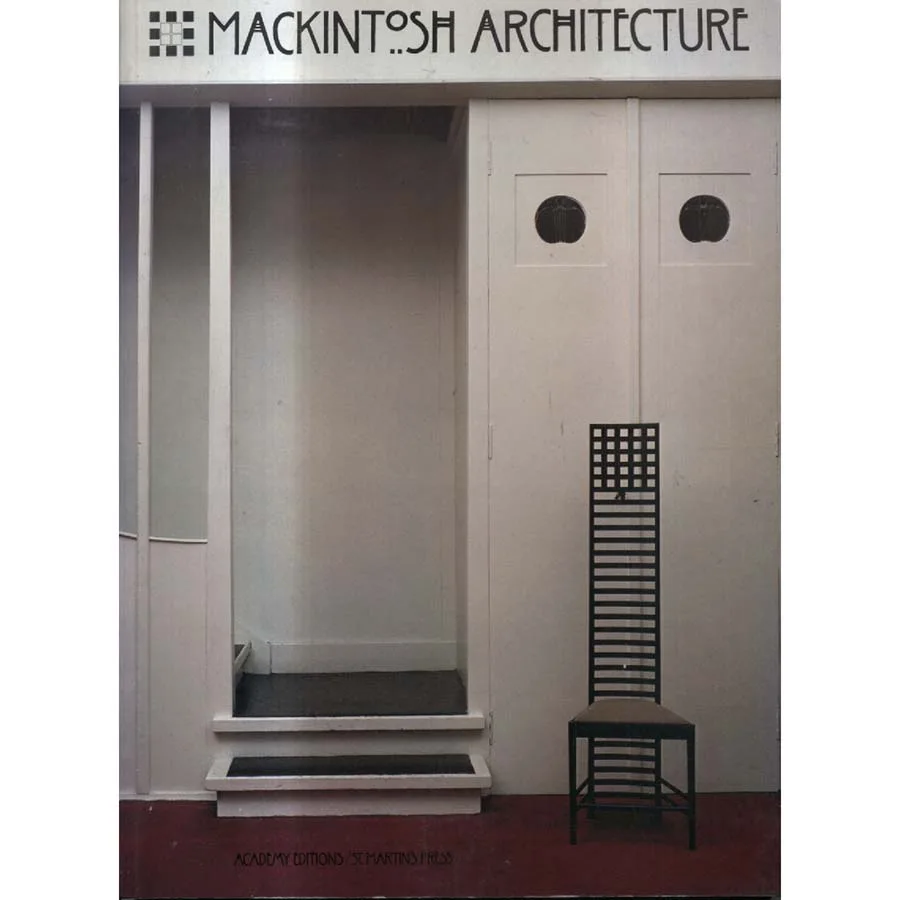
Publisher: Academy Editions
Format: Paperback
ISBN: 1854900145
Small credit clarification: Jackie Cooper is the editor of this volume; it also features a foreword by David Dunster and an introduction by Barbara Bernard.
Charles Rennie Mackintosh had the inconvenient habit of designing almost everything he encountered. Buildings, rooms, furniture, fittings, stained glass and lettering all received his attention, presumably because leaving an ordinary chair untransformed would have represented an intolerable surrender to mediocrity.
Edited by Jackie Cooper, Mackintosh Architecture presents the complete buildings and a selection of projects by one of Scotland’s most distinctive architects. Published by Academy Editions, it brings Mackintosh’s architectural work together in a substantial visual survey, allowing readers to move beyond the familiar elongated roses and discover the formidable buildings in which his decorative imagination was given walls, windows and plumbing.
Mackintosh emerged from late nineteenth-century Glasgow, a city then rich in industry, soot, commerce and people requiring places in which to conduct all three. From this vigorous environment he developed an architecture combining Scottish tradition, Arts and Crafts principles, Art Nouveau, modern geometry and an apparent determination never to place a window exactly where a conventional builder might expect one.
Among the celebrated works represented are the Glasgow School of Art, Hill House, Scotland Street School and Mackintosh’s remarkable tea-room interiors. These buildings demonstrate his ability to combine severe external forms with interiors of startling delicacy. From the street, a Mackintosh building may appear to be contemplating Presbyterianism; inside, it has secretly arranged flowers.
The Glasgow School of Art remains his architectural masterpiece: bold, functional, asymmetrical and filled with carefully orchestrated light. Mackintosh treated windows not merely as holes required by building regulations but as active parts of the composition. Walls, staircases, furniture and fittings work together so completely that moving a chair six inches might feel like an attack upon the entire artistic programme.
Hill House shows the domestic side of the same vision, although “domestic” here does not mean allowing the occupants to buy whatever curtains happened to be on offer. Mackintosh and his wife, the artist Margaret Macdonald, helped create a total environment in which architecture, furniture and decoration formed a unified whole. The fortunate resident received a house; the less fortunate resident discovered that replacing a lampshade required consultation with the architect.
The volume also includes selected unrealised projects, revealing the breadth of Mackintosh’s ambition and the cruel habit of architecture to remain on paper when clients, money or practical circumstances fail to cooperate. Drawings and plans show ideas that were never built, leaving them permanently protected from damp, alterations and committees proposing tasteful PVC replacement windows.
Through photographs, plans and architectural documentation, the book allows the reader to examine Mackintosh’s buildings as designed objects rather than merely attractive cultural landmarks. His handling of mass, line, proportion and light can be studied alongside the decorative details for which he is so widely known.
Mackintosh’s architecture feels simultaneously rooted in Scotland and startlingly modern. Baronial forms and traditional materials coexist with stripped surfaces, abstract geometry and interiors that anticipate later European Modernism. He belonged to Art Nouveau, but never quite behaved himself within it.
His career was not a smooth procession of applause and commissions. Professional disappointments, financial difficulties and changing fashions restricted his later architectural work. Like many innovators, Mackintosh enjoyed the historical privilege of being insufficiently appreciated while alive and exhaustively celebrated once unable to benefit from the gift shop.
This book is consequently more than a parade of beautiful interiors. It traces a body of work that helped reshape modern architecture and design, demonstrating how a relatively small number of completed buildings could exert an influence far beyond Glasgow. Mackintosh proved that architecture could be practical, symbolic, austere and decorative at once—provided somebody sufficiently obsessive was allowed to design the doorknobs.
An excellent choice for architects, designers, students, Mackintosh admirers and anyone who has ever suspected that their own home would be vastly improved by a ladder-backed chair too elegant to sit on. It is equally suitable for the armchair visitor wishing to inspect Scotland’s architectural treasures without encountering rain.
This copy is in Very Good condition, showing only modest evidence of previous ownership and remaining clean, sound and highly presentable. It has survived better than several important Mackintosh buildings, although admittedly books face fewer planning disputes.
Offered by Crappy Old Books, where the architecture is mostly shelving, the design philosophy is “fit in one more book,” and no object is rejected merely because its chair has an unusually vertical back.
Keep browsing: See more Architecture books Other books by Jackie Cooper
